8 minute read
School Lunch Planning: A Five-Day Lunchbox System
Plan five practical school lunches with repeatable mains, produce, snacks, packing steps, safe storage, and student participation.

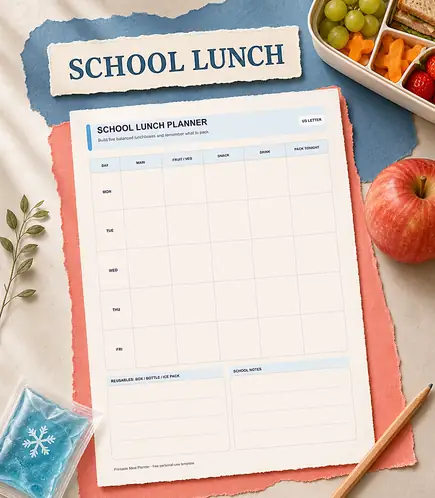
A useful lunchbox system reduces morning decisions without packing five identical meals or buying a separate set of ingredients for every day. The key is to repeat components intentionally, match food to storage and school rules, and move as much safe preparation as possible to the previous evening. Student input can focus the choices without making packing unpredictable.
The plan will provide five complete lunchbox combinations, a short preparation sequence, and a reusable packing checklist that another family member can follow. This guide turns that outcome into a repeatable paper workflow rather than a perfect menu that only works once. Start with the information you already have, make the few decisions that reduce the most friction, and leave visible room for the week to change.
Choose two or three dependable mains
The main item carries most of the lunch decision, and too many unique choices create unused packages. Dependable repeats are easier to shop and pack. Select mains that fit the student's preferences, the available storage, and realistic eating time. Alternate them or change the filling rather than inventing five unrelated lunches.
For example, wraps can appear twice with different fillings, while pasta salad or a thermos meal provides contrast on another day. On your planner, write the main first and leave the smaller components until the five-day pattern is visible. Review that note at the end of the week so the next plan reflects what actually happened rather than what you hoped would happen.
- Confirm the food can be eaten within the available time.
- Follow school allergy policies.
- Avoid untested meals on the busiest day.
Complete each lunch with simple components
A list of snacks is not always a complete lunch, while an oversized main may come home unfinished. Visible component categories support practical balance and packing. Add fruit or vegetables, a suitable snack or side, and a drink as appropriate. Repeat washable, portionable ingredients across several days.
For example, cucumber and fruit can support different mains, while yogurt or a shelf-stable alternative may fit selected days. On your planner, fill one component column at a time across all five days to reveal repetition and gaps. Review that note at the end of the week so the next plan reflects what actually happened rather than what you hoped would happen.
- Choose produce that holds up after packing.
- Match portions to the student's normal lunch appetite.
- Use packaging the student can open independently.
Plan temperature control and containers
A lunch is only useful when it stays appropriate to eat and arrives without leaking. Storage needs should be part of planning rather than a morning afterthought. Mark cold, hot, or shelf-stable items and pair them with the necessary ice pack, insulated container, leakproof box, or separate dressing cup. Follow local food-safety guidance.
For example, a chilled wrap may need an ice pack, while a warm thermos meal requires proper preheating and careful closure. On your planner, write the required container beside any meal that differs from the normal lunchbox. Review that note at the end of the week so the next plan reflects what actually happened rather than what you hoped would happen.
- Check seals and container condition.
- Keep wet and crisp components separate.
- Teach the student how to handle reusable pieces.
Move stable work to the night before
Morning packing becomes difficult when every item must be washed, portioned, and located at once. A defined evening list protects the routine. Pack stable items, wash suitable produce, fill the water bottle if appropriate, and place containers together. Leave quality-sensitive assembly for morning.
For example, portion crackers and pack utensils at night, then add a freshly assembled sandwich and ice pack in the morning. On your planner, write only the tasks that must remain for morning so nothing depends on memory. Review that note at the end of the week so the next plan reflects what actually happened rather than what you hoped would happen.
- Refrigerate perishable items promptly.
- Keep the lunchbox near the prepared containers.
- Return cleaned ice packs to the freezer.
Give the student one clear responsibility
Participation builds ownership and provides preference feedback, but an open-ended pack anything instruction can create gaps. One stable responsibility is easier to learn. Assign an age-appropriate task such as choosing fruit from two options, packing a napkin, refilling a bottle, or returning containers after school.
For example, an older student may select and pack the produce component from a prepared bin each evening. On your planner, place the student's task on the reusable checklist rather than renegotiating it daily. Review that note at the end of the week so the next plan reflects what actually happened rather than what you hoped would happen.
- Demonstrate the task first.
- Keep options limited and available.
- Review school rules for independent packing.
Use returned food as planning information
Food may return because of preference, portion, limited eating time, packaging difficulty, or temperature. The reason matters more than simply noting that it was uneaten. Ask a neutral practical question and adjust one variable. Keep safety in mind when deciding whether returned food can be reused.
For example, a sandwich may be acceptable but too large, or fruit may remain because the container was difficult to open. On your planner, write one packing adjustment for the next week instead of immediately removing the food forever. Review that note at the end of the week so the next plan reflects what actually happened rather than what you hoped would happen.
- Separate time and packaging issues from taste.
- Avoid pressuring the student to finish.
- Consult appropriate professionals for feeding or health concerns.
Make the plan work for you
A five-day lunchbox system should become easier with repetition. Use a small rotation of mains, repeat practical components, attach containers to the plan, and let returned food improve the system without turning lunch into a test. Begin with this one action: check the school's current food, allergy, refrigeration, reheating, and container rules, then ask the student for two dependable main-item choices Keep the completed sheet where you will see it, make one adjustment after the week is over, and reuse the parts that genuinely saved time, money, or attention.