8 minute read
How to Build a Four-Week Recipe Rotation
Build a four-week recipe rotation with meal themes, proven favorites, effort balance, seasonal substitutions, flexible slots, and review ratings.

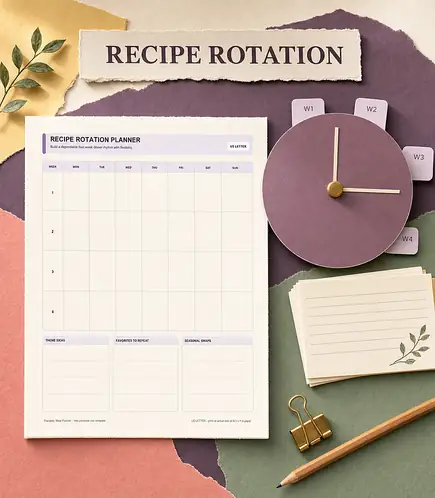
A recipe rotation reduces the blank-page problem without forcing the household to repeat the same twenty-eight dinners forever. The useful unit is often a flexible meal theme supported by proven recipes, seasonal substitutions, and open slots. A four-week cycle is long enough to create variety and short enough to remember what worked.
The rotation will provide dependable starting points for every week while preserving space for leftovers, events, new recipes, and changes in price or season. This guide turns that outcome into a repeatable paper workflow rather than a perfect menu that only works once. Start with the information you already have, make the few decisions that reduce the most friction, and leave visible room for the week to change.
Begin with proven meals, not aspirational bookmarks
A rotation should reduce uncertainty. Filling it with untested recipes transfers the blank-page problem into a more complicated system. List meals you can prepare, the household generally accepts, and the schedule can support. Add new recipes only in designated experimental slots.
For example, a dependable soup, taco meal, pasta, tray bake, curry, and grain bowl provide stronger anchors than a folder of unread recipes. On your planner, mark each meal quick, standard, or project to reveal effort balance. Review that note at the end of the week so the next plan reflects what actually happened rather than what you hoped would happen.
- Use recent real meals.
- Include low-effort and pantry options.
- Remove favorites that no longer fit the household.
Use themes as containers, not rules
Themes simplify choosing while allowing ingredients to change. Rigid themes can become another obligation and create conflict with schedule or price. Choose broad formats such as soup, tacos, pasta, bowls, tray meals, or breakfast-for-dinner. Let the specific protein, produce, and flavor vary.
For example, a bowl night can use rice and beans one cycle, then grains, roasted vegetables, and another protein in the next. On your planner, write the theme in the rotation and keep two proven options beneath it. Review that note at the end of the week so the next plan reflects what actually happened rather than what you hoped would happen.
- Keep themes broad enough for substitution.
- Avoid assigning a demanding method to every week.
- Retire themes that create no real decision advantage.
Distribute cooking methods and effort
A rotation can accidentally group several oven meals, long recipes, or unfamiliar dishes into one week. Balance is visible only across the whole cycle. Review each week for quick, standard, and project meals, then vary stovetop, oven, no-cook, slow-cooked, and reheated options according to available equipment.
For example, a project meal on Saturday can be followed by leftovers or a freezer dinner rather than another full cooking session. On your planner, use a small effort mark and move meals until each week looks realistic. Review that note at the end of the week so the next plan reflects what actually happened rather than what you hoped would happen.
- Count cleanup and advance prep.
- Match projects to quieter days.
- Keep one very easy meal in every week.
Build ingredient bridges within each week
Rotation prevents menu repetition but can still create waste when every meal uses unrelated ingredients. Bridges improve shopping efficiency. Look for two or three ingredients that can cross meals in different forms. Keep the shared ingredient visible without forcing complete leftover dinners.
For example, herbs can flavor soup and bowls, cabbage can support tacos and stir-fry, and roasted vegetables can become a side and lunch. On your planner, draw a small line between meals sharing a perishable ingredient. Review that note at the end of the week so the next plan reflects what actually happened rather than what you hoped would happen.
- Reuse high-risk perishables first.
- Change flavor or texture between uses.
- Avoid buying bridge ingredients in oversized quantities.
Reserve flexible and seasonal swap slots
A rotation must absorb invitations, travel, weather, price changes, and seasonal availability. Completely filled cycles create pressure and waste. Leave one flexible dinner each week and write substitutions for ingredients that vary strongly by season or price. Use the weekly review to finalize.
For example, a soup anchor can become a lighter bean meal in warm weather, while a vegetable side can follow what is abundant. On your planner, label open slots flex and list one pantry backup for the cycle. Review that note at the end of the week so the next plan reflects what actually happened rather than what you hoped would happen.
- Do not treat open slots as missing content.
- Use seasonal swaps that preserve the meal format.
- Keep event-heavy weeks less detailed.
Rate meals by repeat value
A rotation should evolve as schedules and preferences change. Repeating a low-value meal simply because it occupies a square defeats the system. After the cycle, rate meals repeat, revise, seasonal, or retire based on enjoyment, effort, cost, and leftover usefulness. Replace only the weak slots.
For example, a meal may taste good but move to weekends because its cleanup is unsuitable for Tuesday. On your planner, write the rating directly beside the meal and carry only approved entries forward. Review that note at the end of the week so the next plan reflects what actually happened rather than what you hoped would happen.
- Consider household feedback.
- Separate recipe quality from scheduling mismatch.
- Add new meals slowly enough to protect reliability.
Make the plan work for you
A rotation is a reusable decision framework, not a permanent calendar. Anchor it with proven meals, use themes and ingredient bridges, and keep enough open space for real life to enter. Begin with this one action: collect fifteen to twenty dinners the household has eaten successfully and sort them by effort, cooking method, and broad meal format Keep the completed sheet where you will see it, make one adjustment after the week is over, and reuse the parts that genuinely saved time, money, or attention.